
This is where I grew up and where my mother still lives. It may not look like much, but it is one of the nicer apartment buildings in my Queens neighborhood. My grandmother lived a few blocks away, in a lower-income apartment. When I was in elementary school and my mother went back to work, I went to my grandparents after school. My grandmother made an excellent tuna fish sandwich, with chopped celery and dill.

My father was a physical therapist at a city hospital and my mother still works in publishing, so they never made that much money. They worked hard to put me through two very expensive private colleges, just so I could obtain two completely useless degrees — a B.A. in English and an M.F.A. in Film. I was totally spoiled by them.
I had an excellent childhood growing up in the Flushing/Kew Garden Hills area of Queens. The public school was good, the public library was two blocks away, and the neighborhood was incredibly diverse — blacks, Jews, Puerto Ricans, Indians, Chinese. I’m still good friends with guys from the neighborhood who I’ve known all my life. They’re the first people I see every time I fly into New York.

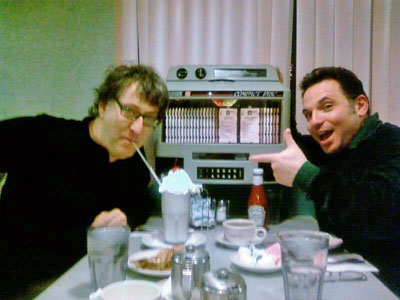
I am so diverse — here I am with my Jewish childhood friend Barry at the Blue Bay Diner in Bayside last week, which looks exactly the same inside as it did when I was in high school.
When I was a child, Queens felt isolated from the excitement of Manhattan, but it was close enough to travel to by subway. (…ok, first you take a bus to get to the subway) My parents took me to museums and concerts all the time, so I was able to participate in the “high culture” of the city. We also lived near Queens College, which had a symphony orchestra. I spent many weekends in the audience with my parents, falling asleep to Schubert.
Although the stores in my neighborhood weren’t very fancy (still no Starbucks!), you could get everything you needed just by walking down the block. There were grocers, a bakery, a Radio Shack, a cleaners, a pharmacy etc. This was perfect for my parents, who didn’t drive a car. It also created entertainment for me. After school, my friend, Rob, and I could pass several hours just stopping in the Kissena Boulevard shops, or reading the comic books in the stationary store.
I only felt embarrassed about “Queens” once I went to Columbia, and met rich kids from the Upper East Side, Beverly Hills, Boston, etc. They had actually gone skiing in Aspen and visited museums in Florence. All of a sudden, Kissena Boulevard was very small time. I began to feel ashamed of my background, like a Jennifer Beals in Flashdance, moving from the steelmill to the hoity-toity ballet studio. It felt as if the entire borough of Manhattan looked down on Queens. The only reason to visit Queens was to go to the airports or see a sporting event. There was even talk about building a new stadium in Manhattan, so there would even be less reason to travel to Queens. Queens was the home of misfits, from Archie Bunker to Ugly Betty. During snowstorms, Manhattan was quickly shoveled by the plows since it is the center of the business and tourism worlds. Queens was always plowed last. Queens had her big moment in 1963-64 when the World’s Fair was in Flushing Meadows Park, but then most of the fair buildings was just left behind to decay.

“Sorry, we don’t have enough money in the budget to fix the NYS Pavilion.” – Mayor Michael Bloomberg
Eventually, I learned to embrace my Queens neighborhood. There was a cool mix of people on the street, and it felt more “New York authentic” than many of the streets of Manhattan. Today, “Sesame Street” reminds me of Queens, not Manhattan. Big Bird could never afford Manhattan. Sadly, whenever Sophia comes with me to visit my mother, I’m always disappointed that she can’t see the area in the same positive way I do.
“It looks like a slum,” she said recently, as we walked down Kissena Boulevard. This hurt my feelings, especially because, in my heart, despite my romantic view of the neighborhood, I believed the same. At one time, the street was lively, with all sorts of shops and ethnic food. Gene Simmons, who grew up nearby, even named his group KISS, after Kissena Boulevard. Now, the neighborhood has deteriorated almost beyond recognition.
Half of the stores on the block are gated and closed — some stores have been empty for five years! Can’t the management company find any tenants? What happened to the bakery, the pharmacy, the seafood store, the stationery store, the women’s clothing store? Surely some business can make a profit here? People are afraid to walk outside at night because everything looks so abandoned. Why has this happened?
Perhaps the answer can be found on the website of the management company, Pelcorp. On the site, they advertise the entire block, not as available individual stores catering to a community, but only as a 240,000 sq. ft. shopping center. There had been rumors that the landlord isn’t renting out the stores because it’s interested in selling the entire block to a big-box entity like Kmart. This might explain why no stores never seem to be rented, despite having “For Rent” signs plastered on the gates of shuttered stores. Is the management company waiting for the opportunity to unload the entire property at once?

A view of Kissena Boulevard at noon, a far cry from what this busy street used to look like.
The management company has every right to sell the entire complex if they want to, but should they be allowed to thrust the entire neighborhood into a downward spiral? Who wants to live in an area where more than half the stores have been closed for years?
It is pretty sad state of affairs. I remember how The Garden Bakery made the best onion rolls I’ve ever tasted. There was “Sweet Donut,” a little coffee shop/donut store. Dr. Sakow, the friendly optometrist, fitted me with my first pair of dorky eyeglasses in the third grade. All of these stores are now gone, with no replacements.
Even if the management company does want to sell the entire property, shouldn’t they at least be responsible for its upkeep? What about all the garbage and graffiti everywhere? Why should I be embarrassed to show my wife the “old neighborhood?” Why should my mother have to walk past the junk in the parking lot? People still LIVE in the neighborhood.
At one time, the landlord/management company was a local one, headed by a New York builder. He was always seen around the area because he also created middle-income housing across the street. After his passing, his son took over the real estate property, and it didn’t surprise me at all that his management company is based in Palm Beach, Florida! Out of sight, out of mind.
From their website:
Our President, Prescott Lester, is the fourth generation of Builder Developers. He is responsible for building and developing nearly 3,000 residential units in Palm Beach County, Florida. Projects included Lakes of Laguna in West Palm Beach with 2,204 residential units and Cascade Lakes in Boynton Beach having 556 dwelling units.
Mr. Lester’s Greatgrandfather began building in Brooklyn, New York around the turn of the century. He was followed by his son David Minkin who became one of New York City’s Master Builders. Mr. Lester assisted and succeeds his great uncle, David Minkin, in running the family’s building, management and brokerage operations.
Here is a promotional photo of the late David Minkin, Prescott Lester, and former NY Mets (yeah, Queens!) pitching great Tom Seaver, who has apparently sold his New York baby boomer appeal for some hard cash.

Despite a history of New York building, the fourth generation of builders now “specializes in the marketing and sale of luxury properties in Palm Beach County. This includes waterfront, country club, and other estate properties.”
The Kissena Boulevard holdings, one of their four retail holdings still in New York, must be their least attractive holding, compared to their shiny new malls in Florida. No wonder they seem so disinterested in the upkeep of Kissena Boulevard!
I talked to a few people in my mother’s building and they are very unhappy with the way Kissena Boulevard looks. Some say they would even move away, if they could afford it. The shopping area is pretty disgraceful, and much of the blame must go to the management company. They have played a major role in making the area look like a slum. Of course, since Pelcorp is in Palm Beach, and the executives don’t get to come to Queens very often, I’ve included some photographs of Kissena Boulevard for Prescott Lester and his partners to see.

The Pharmacy, now closed, the letters falling from the sign

The Laudromat, closed

The shoe store, closed

The graffiti along the “Wholesale Liquidators” wall

The garbage along the wall, opposite the closed shoe store

The kosher deli, closed

The Rainbow Women’s Clothing Store, closed

The pharmacy, closed, is now a haven for pigeons

The Bakery, closed for years

The fish market, closed

Ugly graffiti and disrepair along the property walls


I love this post. LOVE it.
Maybe it is because even though it is a million worlds away from my homogenized Mormon upbringing I understand it all.
I am very sentimental about my childhood home and neighborhood. I was devastated when my parents moved while I was at college. Even though their new home was much nicer, it wasn’t as wonderful to me.
P.S.
So does all this mean that you’re still “Jenny from the block”?
P.S.S.
It’s really late…Can I get a “Forgiveness Pass Due To Exhaustion” for that last bit?
it’s a shame that the street is no longer as vibrant and bustling as it was.
i stayed in queens when I was in NY, probably fairly close to there and it was interesting. (like, i prob wouldn’t want to live there but it felt quite comfortable and easy to get around)
That is a terrible shame!
the little village where i grew up still retains it’s charm, even though it has amalgamated with the city i now live in, but that’s mostly because it’s where our mayor lives and it’s what she wanted. my daughter is currently in manhattan doing a field study on it’s urban planning success, maybe they should have gone to queens instead.
I am surprised at how similar Queens looks to so many rural communities here after a walmart has moved in. It’s sad. And not just in a nostalgic, things aren’t the same kind of way, but a present things aren’t the way they should be, or could be.
Right ON, Neil! I hope you’ve already emailed this post to Prescott Lester…or are maybe planning to send it to him in Palm Beach via certified letter…with the kind of receipt that HE has to sign for in person. (You’re gonna send it to Bloomberg, too, right?) This post made me tear up because this has happened to so many of our little hometowns and neighborhoods, including mine. As Caron noted, sometimes Wal-Mart is the culprit–that’s what did in the downtown in my little town. Please keep us posted on what happens after you send this to Pelcorp. Shall we bombard them with emails on your behalf? 🙂
Please don’t let Queens become like Florida; it has no personality! You were lucky to grow up where you did. That is the real New York.
What Queens needs is an influx of gay residents… that usually gets the ball rolling on neighborhood resortation.
Amen Finn!
I loved reading this post, loved it. The sense of place, the sense of loss, the photos, the research, the call to action.
And I haven’t had a good onion roll since my dad pulled the family out of NY in 1974….
Caron is right. Queens looks like so many other places in the U.S. today. Really quite sad.
Sorry to hear about your old neighborhood, Neil. It’s painful to see.
I totally understand where you’re coming from (and where you came from). I grew up in a small town in NJ that could be in better shape today. Although we don’t have all the closed stores, things have gone downhill. I feel the same nostalgia for the older, better days.
It must be so bittersweet to visit your old neighborhood, with all those businesses closed up. It looks like it was a really nice place to grow up.
I recently took my husband back to the neighborhood where I grew up and had a similar experience. It was heartbreaking to see how run down it had become- and to know my husband will never know it as the wonderful place I played in as a child.
I love this post, too, and can relate on so many levels. My hometown in West Virginia isn’t New York, but the similarities of disrepair and neglect are just as evident. And just as heartbreaking.
Still, it’s home, you know?
Yes, of course you know.
that makes me sad. 🙁
My mother still shops there all the time, where the old Wainrites used to be. I remember that store fondly, but it’s gone now.
My mom sent me to another store, a check cashing place, last year to get my watch fixed when I was in town.
She warned me about the polish lady who fixes the watches, who is nice, but watch out for her mom who makes nasty comments about everyone in Polish.
My mom never lets on that she understands.
The ethnicity of that neighborhood has changed tremendously since our childhood. It’s heavy Russian, Polish, and Palestinian now.
BTW take a look a few blocks up in Kew Garden Hills and see how the place is booming.
Wow, I could find my way around there with my eyes closed. I actually shop on Kissena relatively often. Families we know who live in the Electchester buildings, or in the Dara Gardens apartment complex, use the remaining Kissena stores too, because of proximity.
I find that Kissena Farms still has the most variety and best prices of any of the area fruit stores. My husband likes it because he’s foreign, and with its earthy, grungy feel he says it is “what a fruit store should be”. Plus, my kids like seeing the lobsters in the tank. But you have to be willing to deal with garbage-laden parking lots, smelly cess-pool puddles, and icky shopping carts (I once found an abandoned crate of kittens in one!)
Also, Pathmark on nearby Aguilar Ave. has great prices on groceries, and a sizable kosher selection. That’s my stock-up place.
Growing up, we lived even closer to Kissena in a townhouse we rented when we moved to the area in ’84. Wainrite was my mother’s shopping haven, as she doesn’t drive and it was the closest store in walking distance. I still remember the big rubber bouncing ball we got there from those ball cages near the register.
Until a few months ago, our bank was Astoria Federal, right on Kissena. To echo your sentiments, Neil, I eventually switched over to another bank because walking around in an area that’s deserted while going to deal with checks or withdraw cash felt a little, well, creepy.
There used to be a deli on the block of Astoria, right across from Wainrites (I think it was kosher, definitely not glatt) where we often went for a hot dog and those old-fashioned Dr. Brown’s soda in the glass bottles.
My brothers got their bar mitzvah suits in the men’s clothing store that is also no longer.
While it’s true that Main Street a few blocks away is bustling, overall the neighborhood is a little shabby, and not all of the business that close reopen in much of a timely manner.
It is somewhat cleaner on Main Street these days thanks in part to the men of The Doe Fund, which helps the homeless find employment doing cleaning and general caretaking of public spaces. They ought to bring them over to Kissena, as there’s plenty of work.
Thanks for highlighting the local situation here. It’ll be a huge shame if things continue to slide downhill. Regardless of whether developers have their sights set on the area, it ought to look better than this!
Great post Neil. It seems it has become more and more difficult for neighborhoods and small towns to remain vibrant, since most people seem to prefer big shopping malls.
Such a great post, Neil.
Wonderful post Neil. It reminds me of how I felt the last time I went home.
So interesting and sad. That neighborhood is so ripe for revitalization but I wonder if it will ever happen. It could turn into a hip Silverlake or Echo Park if someone takes the lead but of course that’s dependent on local residents who would want and work for a new commercial corridor. I agree that an influx of gays would do wonders for the hood. It looks like the neighborhood doesn’t have a strong ethnic identity at the moment so it can’t even turn into one of those great pockets we have in L.A. like Little Ethiopia on South Fairfax or the Thai neighborhood in Hollywood. Those pictures just look depressing as hell. (I love the one of you and Barry, though–he looks so much like “a guy from the neighborhood!”)
Prescott Lester should be ashamed of himself.
I am Born & Bred in this Neighborhood. So I can attest to what you’re talking about first hand.
I grew up and still live in Electchester, and am as upset about the state of the neighborhood as you are.
This was an amazing visual insight into where you grew up. So sad to see a place fall into such disrepair and emptiness. I hope it has a rebirth soon!
What great insight to where you grew up, I love this post. I’m sorry your “home” seems to be deteriorating.
God, that’s depressing. There are parts of my old stomping grounds (Union Turnpike) that look similar, but overall, it’s done pretty well for itself; even got a Barnes & Noble and a Coldstone’s not too long ago, while still managing to retain a few of the mom-n-pop shops. Not many, but a few.
And, an aside: I practically LIVED at Blue Bay as a kid; it was my parents’ favorite diner in the world. When, I got to be a teenager, my friends and I hung out at Hilltop, however. But when I go home now, it’s Blue Bay we go visit, usually on the way home from the airport. Their fries are to die for.
For those who know the area — I don’t think this has anything to do with the “changing” area. In some ways, there is less crime than years ago, when the “welfare” housing was down the block. There is plenty of retail activity around. There are three banks within a block of each other — not something you usually see in a depressed neighborhood. There are stores on the adjacent block. I’m specifically talking about this section of Kissena Boulevard that is down the block from my apartment building. I’m sure some Russian or Pakistani grocery would do well there. I’m most upset about the management company not taking care of the property and letting shops sit there empty for years, gathering garbage, as if this doesn’t affect the lives of the local residents, both aesthetically, economically, and even spiritually. At least sell it to Kmart already!
Hey Neil hits me where it hurts (or where the love is?) too. I grew up down the road in Queens Village. My father was NYPD, we had HIP insurance, Dr cohen was initially in a little building in Fresh Meadows, then over to Kissena Blvd just north of the LIE. My neighborhood in Queens Village, Bell Park Manor Terrace on Hillside and Springfield, is ethnically different now (and diverse) but pretty as ever. It’s the stores that have gotten ugly, without any of the old character that gave the streets a warm look. And that could be in the dead of winter, those winters we loved when it snowed a ton and the schools closed. We just keep it warm in our hearts, right?
Folks, remember this post every time you shop at Wal-Mart, K-Mart, or a shopping mall with chain stores. Please try to shop at independent stores located in the community core whenever possible. Money talks.
Lovely post Neil.
This made me really sad 🙁
Plain Jane — I’m not totally against Kmart, Walmart, etc. I love independent stores, but it is difficult to fight the power when local residents actually want these stores for better prices, etc. I shop in Target, etc.
Kmart on Kissena Blvd. might actually be good for the area. My biggest complaint isn’t with Kmart, but the management company that clearly wants Kmart money, but just seems waiting around letting the street decay until the right time to sell it.
I call it “kid-vision.” Everything looked better when we were kids. Very sad about your old neighborhood. Hopefully, something will happen soon to revitalize the neighborhood.
I, too, grew up in a small town. The shopping district where I used to ride my bike past Newberry’s and various delicatessans is now full of chain stores like Crate and Barrell, Victoria’s Secret, Cheesecake Factory, etc. The small town, independent shop owner vibe is almost gone. Sigh.
The developers are waiting out gentrification. You know, when all the residents are almost gone and they start selling “luxury condos” and giant box stores start moving in. I lived in Queens from 1986-1994 (Ozone Park, the former home of the Bergen Fish and Hunt Club) (cough cough Gotti cough cough) and it was going downhill when I left. You probably would have had a better time walking the streets of Bed Sty where all the noveau hip live. No more crime in Bed Sty, just a good time!!
Oh Neil… This is so awful. It’s always bad news when a developer who doesn’t live in the area takes over but this is truly destructive. Copies of this post should be sent everywhere that can help.
There was a strip mall near my mom’s house that lost all of its tenants a few years ago. It became a real eyesore. About a couple of years ago, they tore it down and built new townhouses on the land.
I knew someone who owned property, and took the attitude “milk it for all it’s worth”. He didn’t keep it up, let it deteriorate, etc. Disgusting. Disgusting way to treat property you own, and disgusting way to treat the people living in the neighborhood. Just because someone has enough money to own or manage property, doesn’t mean they deserve it.
It is a sad sight…this familiar neighborhood of yours. I’m sure it hurts to see it in its present state.
However, I do love the name of the closed pharmacy: Script City. Perhaps that was a subliminal message for you to go to film school…
Yeah, that’s really sad. The Fiance grew up in Rego Park. We recently went back to his old neighborhood. He said the same kind of thing as you..it looks more dilapidated than it did. And his old house was torn down and a huge ugly duplex built on the land.
Big management corporations are the devil.
You’re such a great writer.
Wonderful, beautiful post, Neil. I know nothing of New York, but I could say the same about my hometown, and it’s slow death. Maybe I should write about it.
Thanks for that, it really got me thinking.
That is Horrendous, Neil….Sad Sad Sad…! One wonders how and why the owners of this entire block could have lost such interest in the individuals that live there and who need these shops….I think I would find it deeply depressing to see all my childhood haunts closed and just rotting away in such a non-caring manner….I feel for your mother, who must miss many of these stores….Where does she shop? Is there another Kosher Deli she can go to? It must be depressing for her, too!
I am not familiar with that particular Street, but having grown up, waaaaay before you, further out on that same LIRR line—I am familiar with the names of Flushing and Bayside and Douglaston, etc., etc…And I thought about the First World’s Fair…the 1939 Worlds Fair which really put Flushing on the Map…..I have wonderful memories of that. We went there many many times and of course I wish I had a dollor for every time I drove through flushing…later, in the ’50s and some of the ’60’s….and BTW: I had no idea that KISS was named for Kissena Blvd!
This made me so sad. All that beautiful history just ignored. Thank you for sharing your great childhood stories and showing us the pictures of where they happened.
Hats off to you for an excellent post.
I will agree that you were doted on, not spoiled. Your parents gave you everything they have because …that’s what parents were supposed to do. This is so different from today where parents are so caught up in being as cool or cooler than their kids and they just can’t get their ass-sized egos out of the way.
So YAY for Neil’s parents!
As for the slummification, I think the website for the company should also read:
“Mr. Prescott Lester is also damned well trying to forget his middle class roots. His properties in Queens are a mere footnote in the family history, along with memories of onion rolls, kosher delis and pharmacies where everyone knew your name. Today, Mr. Lester lives in Palm Beach with his eighth wife Brittney, where they employ many illegals to do everything for them.”
“It felt as if the entire borough of Manhattan looked down on Queens.”
It didnt feel that way, Neil; Manhattanites do look down on Queens, as well as the rest of the city. I mean, really, is there a term of contempt so altogether base and loathsome as “the bridge and tunnel crowd?” And be happy you still have the buildings to look at. I’m from Highbridge, Woodycrest Avenue and W. 167th Street, and absolutely nothing from my childhood survived the burnout in the 1970’s.
I’m sorry, for the non-New Yorkers, Highbridge is in the Bronx; it’s the neighborhood where Yankee Stadium is located
What a beautiful homage to your childhood home. I’ve always wanted to go to New York, but I think the version I want to go to requires time travel.
Kissena Blvd. Did you know Bobbie Levy who lived there? She went to Queens College, married, and moved to the southwest. A cute short girl with a scratchy voice. So nice to read your lovely memories of the decrepit hood. I had the same sadness with my Upper West Side hood in the seventies-eighties. Now, it’s another kind of sadness: a gated community of sorts, no room for normal folks with normal incomes. Change, it can hurt sometimes. I wonder how you feel seeing your mother still there — she and the hood (and us) aging, and being so far from each other.
first off – do you know what that property on Kissena is worth? a fortune..you may have left nyc, but the money is still here. .. a Jewish boy from Queens moves to Hollywood to be a writer..talk about your cliches.. Didnt I see you on Entourage.. I am Queens Blvd.
I grew up in Electchester, my dad was in Local 3. That part of Kissena was our back yard…we used to go to Wainwrite’s all the time, then to Wholesale Liquidators, and Kissena Farms…burgers at McDonalds..chili at Wendy’s. Sad to see the state of disrepair this part of the old neighborhood is in. I remember that bakery…the owners were the first Jewish people I ever knew and I loved going in there to learn about their religion, the holidays, etc. and of course, to get sweets! My mom would buy challah bread from there and make the best french toast ever! Great post. Thanks for the wake up call and trip down memory lane.
Uh, I think pretty much every commentator on this blog missed the point.
As Neil mentioned, this overall neighborhood is NOT in decline. In fact, it is booming, and property values for retail sites are among the highest in the country. You can’t buy a decent house in this area for under a million. People likening this area to West Virginia or the Rustbelt or the stereotypical “changing” urban neighborhood have no idea what they are talking about.
There are thousands of expensive condo units and huge shopping complexes planned or under construction to the north, in downtown Flushing. To the south, Kew Garden Hills has soaring property values from the rapidly growing Orthodox and Israeli communities. Just try and buy a house in prime Kew Garden Hills.
The issue is that property values are so high that it makes sense to demolish sites and rebuild bigger. This would normally be a good thing for the neighborhood, but this developer apparently is taking his own sweet time rebuilding the site, and the neighbors have to suffer without local amenities.
Thanks very much for this post. I was born and raised in NYC (still living here!) and am saddened by the toll gentrification is taking on the city–in a myriad of ways. It’s good to know that there are others who are seeing and talking about these changes.
I posted a link to this on my blog this morning. Very sad indeed. Also very typical of Queens these days.
From a guy who grew up down the block (Kissena Blvd @ Kissena Park) thanks for a well written piece about the neighborhood.
I think the point is what is this situation is very similar to what is happening to much of Queens. Properties are being allowed to be turned in to something completely out of context to the rest of the community. Either by turning single family houses in to 4 and 5 families dwellings or here, the elimination of numerous stores that served the community. K-mart would do just as well on Kissena as it did on 188th St, which is to say, not well. It doesn’t serve the community of which it is a part of.
Queens has always been diverse and growing up I had friends of every nationality and religion. But then it was about fitting in, making the place you lived a better place. Now it’s about making as much money without thought to the community.
I lived in Electchester from 52-69. I went to 200, 168,Francis Lewis an then Queens College. I even worked in J and J Liquors situated in that very same shopping center. This take on Kissena Blvd is exactly the same as old diehard Dodger fans have of Brooklyn of the 50s.
Face it, the neighborhood changed. My mother moved out as did the others who supported that businesses. Populations changed—look at downtown Flushing. So the businesses changed too.
As children, Kissena Blvd was new and exciting, but now 50 years later, it’s older and falling apart. The state of Kissena Blvd mirrors what’s become of us. It got old.
Thanks for the photos and memories–they will remain fresh and vibrant forever.
I love this entry. I like hearing about your past.
Dear Neil,
Really enjoyed your article (and felt the same way about my childhood.) I also appreciate your concern for the area in its present condition…My parents are still there too..
Hey Guys, Literally grew up hanging out on Kissena Blvd (when you could just “hang out”)- a veerrryyy long time ago – But hey “Regina’s Pizzeria” is still there, I should know, my family has delivered pizza for them for years – what a blast!!!!! went to PS 163, IS 237 & Francis Lewis – the house “my grandparents” bought and I grew up in, has now been torm down – how sad 🙁 progress – yeah right!! – Seeing the empty lot before they “put up a parking lot” (hahahaha-NOT) made me feel “lost”-Thanks for a great piece. “L.S.”
FYI: Pelcorp is an entity with many corporations, their Queens office is on Queens Blvd. in Rego Park.
A sad tale, well told. Better than much of the journalism out there Neil.
That’s the same feeling I get when we’re driving through small towns out here and all the businesses are boarded up. Our little town used to have a grocery store and a hardware store, not to mention a doctor’s office. All we have left is a mini-mart where you can pick up a gallon of milk or gas up the car. And it’s not open Sundays.
I can’t believe how down trotten it all looks even on a sunny day. I remember walking to any or all the stores, they were local they we good and reliable and it was easy on the pocket and easy on the feet. What a shame all local business’ have to go the way of the dinosauors. It breaks my heart to realize that the times they have a changed but not for the better. Neighborhoods are too important not to have the local businessmen and women included in its makeup and diversity. Have we as a society really alienated ourselves from each other so much that we can be over run without a shoot simply because we have no sense of who and what we are anymore. We are all little islands floating, and drifting in a sea of selfish and alturistic behavior, how sad for a generation that wanted to make a difference in the world and now we die with a whimper.
Wow,
I have not been back home for a few years. I lived right across from Parson’s Junior High my old school. Now I live in Florida.
This is very disappointing. Very good article though.
I grew up in that neighborhood too. My heart is broken…Loved the article though.
I was born at Hillcrest Hospital, I grew up on 72nd avenue and 160 street. I went to PS 154 briefly, attended IS 237 in Flushing, went to Jamaica HS and then went tot he State University of new York at Albany, although I attended classes at Queens College one summer. I had paper route at age 12 that covered a wide area, worked for Colony’s Card Shop from age 13 until I turned 16. I then worked for Wainrite’s until I graduated from HS. Although I came back to work for Wainrite’s 2 additional summers before their closing. Growing up there was like growing up in small Norman Rockwell-esque town with great ethnic diversity.
I had a wonderful childhood and I often return to visit my parents and friends that are still there. I now live on Long Island, I am married and have two children.
Wow i never thought it would have turned out like this. When i was young i used ta Bomb the Neigborhood From Parsons jhs to P.s. 165 to Pomonok break dancin and other things. Alot of good times and friends Valentinos pizza, Wainrites,comic store, olinskys
God! I was devastated when I saw how Kissena Blvd looked. I grew up there. It’s dirty and disgusting. I loved your site, it brought back great memories but also alot of tears. Even the pizzeria is not the same anymore. No more wendy’s either. Thank you for showing my neighborhood
Interesting article. I live two blocks from Kissena Blvd.for the last 34 years. It’s been a slow process with the closing stores. I’ve wondered about that Bakery forever. Until your article I didn’t realize just how many stores were closing. You can now add the liquor store to your list. They reopened across the street. I enjoyed reading the comments, it took me back to my childhood. I never thought of Kissena Blvd. as a slum, but I guess all these closing stores don’t make a pretty picture.
Hi there
I am Swiss and still holding good memories about Kissena Bldv 68-39 (Appartment) back in 1986 – 1989. That was the time, when I lived there as a foreigner working for the good old, but past Swissair at JFK!
Reading your comments about slummification makes me feel sad a little bit. I used to have good contacts and friendships to many owners of local stores from that age! Most of them seem to have moved away or closed.
Anyway …
Best regards from Switzerland
Urs
Neil, wonderful writing about a neighborhood I grew up in and knew very well. The original name of the drug store was whalen drug. There were two bakeries Garden Bake Shop and across the street Butterflake Bakery. Host was the name of the delicateesen and it was Kosher. The food was wonderful too. Father and Son was the original shoe store, Miles shoes was two or three stores down the line. Mc Rorory’s was a five and dime store that sold notebooks, makeup and even tropical fish and parakeets. There were no gates on the storefronts. No parking meters. When you parked your bike in front of the store you shopped in, it was still there when you came out. You could always count on seeing a schoolmate, a friend, a neighbor, a teacher or the neighborhood bully. I grew up in this neighbor from 1948 until I was eighteen years old. My mother was there until 1980. We lived on 72bd avenue and 164th street, the first attached houses in the area. Kissena blvd was all a swamp we used to catch frogs and tadpoles there. No stores, Electchester was a golf course. Notice all of the hills it is built on. My humble opinion of the decline of Kissena blvd. This neighborhood was built and formed by the greatest generation. The fathers went to work by bus and subway from this wonderful unusually diverse ethnic neighborhood. Our Mothers stayed home and baked cookies. They cooked ethnic meals from their own roots. They always knew where we were or house house we were in. Mom’s were Cub Scout Den mothers. Fathers were Boy Scout leaders. You went to synagogue, or church. It did not matter if you were black, white, Jewish, Italian, Irish or Chinese. You attend your friends Bar Mitzvah, your friends Conformation. Sweet sixteen’s. The Bar B Q. on the corner of 160th street and 73rd ave. The black neighbors that lived in the neighborhood before any other ethnic peoples moved in sponsored this wonderful Bar B Q. We all were welcomed and we all knew eachothers names and parents names. The common denominator, was Middleclass working people with the desire to educate protect their children and teach the values from our homes that our own parents grew up with. I still live close by my old neighbor , about half an hour away in Nassau County NY. I drive through the old neiborhood every once in awhile. I would love to hear from my old friends and neighbors. Pete Tessler petetessler@optonline.net
Please disregard my poor spelling. Pete Tessler………
Today most people in heavely populated neighborhoods like this don’t realy get to know their neighbors on a personal level. Language and work schedules added to very little leisure time does not afford people to develope the personal relationships that develope over long periods of time. Pete Tessler
This is so sad. The change to corporations instead of small, family owned businesses is killing Kissena Blvd. The neighborhood would be better served by the small businesses that once populated these storefronts. Instead, the company would rather have one rent and a store that doesn’t fulfill all the necessities that the community has.
Sad to report that the anchor department stores, the National Wholesale Liquidator located in the former Wainrite and MCCory buildings will be moving out as soon as all the merchandise is sold. So sad. NWL has
been there since 1984. I remember as a child going with my mom and dad to Wainrites, McCrory’s, Father & Son Shoes, the Food Fair (now Kissena Farms). Nearly half of the stores are currently shuttered and with the closing of NWL, it will be a very sorry situation if the landlord doesn’t take immediate action.
Bryan — I just heard the news. The whole block will be abandoned except for Valentino’s. I would have expected a K-mart or someone would have come in, but now with the bad economy —
Neil, that’s bad news. A block away there’s new development going on. The Wendy’s property is being transformed into an upscale Walgreen’s. The neighborhood isn’t really a slum. In fact the Electchester Shopping Center just two blocks away has been completely remodeled with cobblestone sidewalks, an immaculate Met Food’s store. Every store there has a tenant.
Back to Kissnea Blvd at 71St Ave…. the other side that has Astoria Federal,
Rite Aid, etc has a 100% occupancy. Guess there’s a different landlord on that side of the Street. The old Mobil Station on that same side was torn down and a new group of stores on the ground level will be available. Go figure!
I grew up there & my Mom still lives there. I remember when Valentino’s first opened. I used to get “goodies” from Garden Bakery every Sunday. It’s so depressing when I go there to visit Mom now.
get involved with your neighborhood association..give back..we have to look ahead..queens can become a special place.. kissena blvd..needs help…GET INVOLVED!
I moved into this neighborhood (into the Electchester Development) in 1975 as a newlywed. I still live here. I still love this neighborhood and it hurts to see it withering away. This letter, with photos, should be sent to every political arm possible – local, city-wide, and state-wide.
I attended Queens College in the early 1970’s and this neighborhood was unique. As an African-American I really appreciated this diverse commmunity. Although, I grew up in Williamsburg(Brooklyn,NY), very Hassidic and also
very diverse in those days. Slums are created by the abandonment of the major business players. They leave in their wake boarded up unrented commerical property, disparity, and hopelessness: a gift to the community that gave them the American Dream. Thanks alot, pal!!!
I live on Jewel Ave and have since 1969. My kids grew up in thre neighborhood. I just came across a ring my daughter bought for me in Wainwrights at least 25 years ago. My younger daughter (who lives on “the island”) often asks me “How can you still live there?” The neighborhood has good memories, and my neighbors are the best you can find anywhere. I hope the area will make a comeback soon so i don’t have to defend it!
can i get a job there im a technician in rite aid pharmacy on kissena blvd also and i have tooooo many problems in that place because apparently she doesnt like me but iam a hardd worker
Well you can add Kissena Farms (which you mentioned) to the Closed list.
Remember that old Carvel store owned by the Korean guy next to the Chinese restaurant back in the 80’s? I think that Chinese restaurant is one of the only thing that remains from the old neighborhood lol.
Government alone, stands in the way of new investment.
look again!! Liquidators has reopened it slarger store and Kessena Farms will re-open on November 1st. please update.
Your post is remarkable and brings an insight like none other. I was born and raised in Pomonok houses. I am a registered nurse. My Mom was and RN as well and my Dad a social worker. I went to PS 165 and remember Wainright’s, Olinsky’s, Host Deli…even Copper Penny and Jack-in-the=Box..a few blocks down.
I still live in the neighborhood and am appalled at the condition of Kissena Blvd. Kissen Farms (which used to be Food Fair and Pantry Pride) closed about a week ago. The strangest thing is that they continue to build new commercial buildings further up Kissena (near 71st Avenue) instead of trying to refurbish what’s standing.
It is so sad. I’ve lived in my neighborhood for 50 years but am contemplating moving to Jersey City (sigh)
i lived in kissena all my life, I moved 2 years to Glen Oaks i miss my town kissena so damm much. so much had happend when i had left. alot of stores have closed down but they are reopending the nhl for example if they dont opn i have a tema of people coming in i love my town kissena and i will protecht it al all cost
Im glad to see all the posts. FLUSHING, is/was a prime example of what happened to Greenwich village. THeres no regret to be had in it… it just had it place in time– from the (in)famous World’s Fair to the huge rock/punk explosion in the 80’s– it had its place in time. Gentrification messed it up; some pple think this for better than nought. NYC (manhattan) was always for sale, which is why i move on to Greenwich. Used to be HOT, now– is a joke. A touristy joke. “Hey dude, where do you get those hot t-shirts, those posters, your metal gear?” A few years ago– the Village. 10 years before that– FLUSHING! Go to the ‘Jolly Joint,’ on Main. Now, Greenwich has nothing but TOFU. Flushing has nothing but, qwik-E-Mart scrastch-offs and fish heads. Im not gonna comment any further, but Gene Simmons didnt exactly bring it back to the community, did he? I like your site. No one would ever know. I dont think anyone does. When i grew up as a kid of 5 yrs old, i had skinheads on the elevator, 10yr olds practicing (not PLAYING but PRACTICING Metallica from their parents apts, while their babysitters were glamming up for that night’s ‘concert,’ only a few blocks away. THe ‘gangs’ hung out behind the local Photomat booth, drinkin. No violence, just taking the TIME to act stupid. To be REAL. THe skaters did more of the drugs, but said ‘hello’ to everyone in the neighborhood. Flushing was the place between the cruelty of the CITY, and the dullness of the suburbans (who were just using to learn to use hairspray without inadvertantly committing arson.’
ANYWAY, Love the site, love your stance. No matter where I go, Flushing @ Kissena will have my heart. Where things go from here? Idunno.
THanx for this moment,
Bryan R.Jones 2010
Kissena Blvd is a slum because people like yourself moved away. You decided to leave New York for better surroundings. You never stayed , raised a family and supported the area. Why are you surprised?
Neil you are typical of the liberal hypocrites. You are trying to blame NYC and the Mayor for the problems of Kissena Blvd Flushing as if you and your fellow types are innocent. Your people fled to Five Towns, and Great Neck and L.A. and left behind the poorer people. Why don’t you move back to Queens and deal with the Third Worlders and act like a man instead of whining like a girl.
Brad L,
Many, many different kinds of people dream of moving away from home and finding their fortunes. For many people, this journey greatly broadens their horizons. Open-minded people frequently discover, on these travels, that their backgrounds, and their worldviews, and their politics are actually just one background, one worldview, one politic, among many.
One thing I took away from this photo essay was how much Neil loved the diversity of the old neighborhood. I didn’t find his writing whiny, and I don’t happen to think that girls whine any more than boys. The only time in my recent memory that an adult male challenged *my* manhood, as you appear to do with Neil, it came from a bully (and quite possibly a ‘roided up at that…). I told him I thought he was acting like he was stuck in 8th Grade.
Eighth grade, for most people, is an regrettable time. Our hormones are raging out of control, making us uncomfortable in our own skins. It’s also a time, depending on education and experience, in which it starts to dawn on us just how little we know of the world and just how insignificant our lives are in a cosmic sense.
I’ve been incredibly fortunate to travel the world and meet many wonderful people, which gives me a much fuller sense of my own surroundings, and a greater sense of appreciation for my brothers and sisters. (other humans). I go out of my way to find moments of kindness with strangers, but I will cop to occasionally calling people out when they’ve displaying an unusual sense of cultural narcissism and ignorance, as you have done here.
If you were actually intending to be “helpful” to Neil from a “tough love” standpoint, you could have made any number of complex arguments that touched on community and involvement and self-awareness. What you chose to do, however, appears to be straight out of the 8th-Grade playbook–a less-than-paper-thin definition of manhood. Brother Neil is a gifted writer who puts himself out there again and again and again. It’s a considerably braver lifestyle than most, and you may be surprised to learn that many people consider it quite manly. What a good writer tries to do, or any good artist for that matter, is to whittle away at his surroundings in an effort to try and expose a little truth about what it means to be alive on the planet, right now. Women do it, too–in ways that are feminine, manly and everything in between. People whose narrow worldviews, narrow experience and narrow politics are threatened by such art viewings often react without thinking, changing the topic to something they think they understand, and something they can handle: in this case, a limited definition of manliness.
So help a brother out. If you’re trying to change Neil’s rhetorical ways–or encourage him to raise a kid where the kid’s gradmother may no longer feel comfortable–by trying to make him feel bad, let’s see a thoughtful effort. Dazzle me with your analysis of his post. Make my voice irrelevant with irrefutable evidence of “you and your fellow types” and “Your people.” Force me to bathe in my own hypocrisy.
In short, Brother Brad, show me you have an inkling of what the hell you’re talking about, or even of who you are. If you weren’t meaning to be “helpful” then maybe you could explain to your fellow blog commenters what you *were* hoping your terse anger will accomplish. Because you might just come to the conclusion you owe Brother Neil an apology.
That’s the kind of challenge I’m interested in throwing down. That’s tough love. And that’s manly.
Would like to know the name of these buildings from Pelcorp.
Please reply.
Thank you.
I grew up in an old house on Parson’s Blvd directly in front of the “B” building of Aguilar Gardens. The large city block circumscribed by Parsons, Aguilar Ave, Kissena Blvd, and 71st Ave. defined a huge chunk of my non-school life until about age 10. But I agree with Neil Kramer- it was a great place to grow up despite the mediocrity of our SE class. I could have cared less about Aspen or Fort Lauderdale or Hilton Head. We had Wainright’s, Colonies, Red’s, Star Deli, Baskin Robbins, Jack in the Box, Waldbaums, Dubs, McCrory’s, and well, the list is virtually endless.
We had good people, good friends, and a ton of adventure all around us! Ruben Sutton is right too- diversity was our common bond, creating a painting comprised of literally endless variation. And we are all better people for it. It truly is a shame what has happened to Kissena Blvd. Thank goodness though that Kissena’s one true landmark- Valentino’s Pizzeria- survives as a connection to our past memories of “the street†in the 60s, 70s, and even 80s. Kissena Blvd is due for a change; I hope it finds its Renaissance
Your article brought back so many memories for me! I grew up in Flushing and lived in Campus Hall which is now Georgetown Mews. I also went to PS 165 and Parsons Junior High. It’s so sad that all of those stores that I grew up with are mostly gone. The bakery was awesome and of course Wainrite but I was glad to see that Valentinos is still around. Thanks for posting!
I grew up in that area, played at the 165 park, and actually owned the Candy Store on the corned acriooss from the fruti store back in 1969 when the area was still nice, Yes I remeber all the stores Wainrites, Host, Vleaners, Colony, Top Spot, Kosher Butcher, Garden Bake Shop, Butterflake ( I got all my rolls from them ) I have not been back in some time since I live in Arizona but I am playing a trip back, those were good memories, it is a shame that the area has become what it is, so just remember the good times and the great childhood we all had in that area, PS 165 , Parsons, Campbells, John Bowne, and Queens College,
My parents moved here from Harlem in 1960. I was 6 years old. I went to all the local schools except Parsons. (PS154, John Bowne, Queens College) Hung out at the Park (PS 154) and the Woods. One thing I will always remember is how well everyone got along in that neighborhood even if we were from different backgrounds. Who can forget Alice Crimmins, The Woodsmen, the Jewish guys hanging out on the corner of Parsons and 72nd Avenue, Chops and the Ville. I am African American but a lot of my best friends were Spanish, Jewish, and Asian. Reading this reminds me of growing up before Jack in the box was built, working at Food Fair and Wainwrights buying bread at the Garden Bakery and being sent to Red’s to buy cigarettes for my parents. How about the Kosher Butcher shop and Youngs Chinese restaurant. The Daily News cost 7 cents and everyone dumped their garbage or dug out their lawn soil in the Woods. Those were the Good Old Days. Yes I remember you Robert Sutton. How is your sister? What ever happened to Mitch Green?. Whelan’s is where I bought my first condom. Colony’s is where I bought most of my comic books, The Kosher deli across the street from Wainwrights sold the best frankfurters in the world. Pomonok had a series of tunnels you could walk through and how about the hand ball games played at Pomonok! Let us not forget the pride we all shared when the Mets began to play ball at Shea Stadium. The Q25/34 and Q65 were what we used get out of the neighborhood. Tokens cost 15 cents. Everybody had a Dog and we knew them all by name. Sorry have to stop as I am tearing up! Keep the Faith!!! Power to the People!!!
Which Mitch Green?
Do you remember me? I lived on 72nd Avenue. Did you know Jack Caboroy.
Wow!!! What an article!!!….It was like yesterday, going to Wainwrights, meeting up and having dinner at THE HOST DELI…visiting my best friend, Nadine, and yes her sister Fran…Walking down Kissena Blvd. with friends who I attended Parsons JHS with, shopping, having fun, being free spirits, stopping off for pizza…Those Were The Days…sorry to see it all waste away to garbage!
Hi, i lived in electchester from the time i was born, until I got married 1977. Anyway, I went to college with Nadine Drescher, we went to Nursing School at Bellevue together. If you are still in touch with her, tell her Janie Kasner says hello. I lent her a term paper one semester and she never gave it back to me. Ha! I live in NJ now, but my parents are still there, hopefully, moving out here soon. so nice to hear the old stores and neighborhood again. My best friend worked at wainwrights, i got lots of free stuff when she checked me out!
@ Jane Kasner Garnick: Nadine Drescher is on Facebook
Born and raised in Flushing, family lived on Kissena Blvd for over 30 years. Now living in Florida and it just breaks my heart to see what has become of “my home town”. Thanks for the well written article.
This brings a flood of tears from my eyes. My brothers and I grew up at 70-25 Kissena Blvd., between 71st and Jewel Avenues. It was a good neighborhood in which to grow up, nothing like what I saw in these horrifying photos. I am sad beyond words. I don’t understand what has happened to our country, to pride in one’s country, neighborhood, and values instilled by our hard-working parents. This is devastating to me. My brothers have both been back for a visit, over the years, but I haven’t been able to do so. It was sad enough to hear that Gloria Pizza on Main Street Flushing had closed, but this is a real blow. To all the people who still live in my old neighborhood, you are missing the best years in which I was blessed to grow up in a pleasant, “real” neighborhood that still holds sweet memories for the three of us Singer kids. Why couldn’t those who destroyed “my” neighborhood respect it? WHY?
Hi Susan,
There is a pizzeria in the Pathmark shopping center called Amore, you will be in for a suprise that is where the original Gloria’s owner are. The shopping center is one block west of whitestone bowling alley. The pizza is still great.
Im very sorry but a few years ago I directly asked the employees at Amore…they are not related in any way to Gloria pizza. That was just a rumor
My wiife & I moved into Electchester in1953 when we got married. we raised 2 daughters there & enjoyed the area very much. We moved upstate NY in 1969 when the girls started High School. Some of our old friends still live there. It is ashame what happens to an area afterso many years.
Hi, I lived in Pomonok 67-15 kissena blvd moved out in 1962. Lived in Bayside then Brentwood then moved to Coconut Creek Fl (township) from 1988-until 4yrs ago. My Mother-in-law lived in windmore. Now I am back in NY. I go back and see friends and family. Where do you live in coconut creek alot of people don’t know the place. Love the festival flea market.
I lived at 154-05 71st Ave(corner of Kissena Blvd) 1951-1964. My Grandparents lived at 154-01 from 1955 until the mid 80’s. The comment written by my friend Susan Singer expresses exactly how I feel. This is a now forgotten neighborhood and I feel saddened by it’s current condition. I have so many happy memories of a lively, busy Kissena Blvd. and they will always remain that way. I visited the old neighborhood in 2005 and thought it looked tired and worn, but now it looks dead… So sad for the people who still live there.
What memories! I grew up in Pomonok, 1950’s, and then my parents.bought a small cape cod on 168th St in the ’60’s off 71st Ave. Went to the same schools. Great years!
I have so many happy memories of our wonderful childhood days. I remember the stores, and got my first Gary Lewis and the playboys record in Wainwright!
I know this article is old, but I grew up in the Garden apartments right across the parking lot behind what was once Wainwright’s which eventually became National Wholesale Liquidators. When I read this article I actually got misty eyed… I know places change over time, but this just breaks my heart.. Just this past week I was talking about the bakery and the star deli with my wife.. looking at the photo Aguilar behind Walbaums had me remembering laying in the grass in the 1st court looking up at those buildings and the one’s across 71st ave in Pomonok. It really was once a great neighborhood… I often talk about how diverse it was…
MOst the stores on kissena are closed and they gonna keep closing cus most people around here are losing jobs daily and no money to buy things, and crime round this area is increasing, shootings, assaults, robberies, queens college students getting mugged at night by young men, now the neighborhood majority is blacks, hispanics, asians and afghans, not that many jews like before , pomonok is predominately blacks and Hispanics and the elderly, and the blue buildings on kissena is occupied by Hispanics and blacks but majority that occupies the blue buildings is Afghans. the elderly folks in pomonok don’t come out anymore when it gets dark due to all the problems happening now in pomonok. This July 4th that just past, their were 2 shootings, i think if I’m not mistaken around Jewel and kissena blvd, no one was hurt in the first shooting but the 2nd shooting happen later in the day and it left a mother dead, she was shot in the head, and her son shot in the chest, injured. the crazy part was the 2 shootings were no way connected to each other and happen the same day in the same area. After 8 or 9ish the kissena blvd is dead, no one outside except for groups of young guys roaming the streets in numbers between 2 to maybe 6 or 7 or more. I’m not exaggerating this, i’m just saying what is usually seen by me and my family. this neighborhood has completely changed and is now in my opinion definitely looking like slums. The people in the neighborhood now are between the ranges of being poor or the lower middle class, just enough to survive. It’s disappointing seeing this area like this. Parsons JHS closed down too in 2007 and reopened with the rfk middle school in it and QSI, but there is no more Parsons JHS 168. The wendys is gone, the Blockbuster is gone, the 2 gas stations on Kissena Blvd across the street from National Wholesale are gone.
Living in Maryland now, I was so caught up with rembering the good old days. Then I read your comment and it brought it even more back to life. Yea, I remember, it was the “jews” (as you put it) that ran Pomonok. The “jews” that made everyone else uncomfortable. The “jews” that thought they were better. And we as kids believed it. Now I know you had the same income level that we had to be eligible to live there. Your parents were working class like my banker parents, and you had no more than I did. I am glad that today there is a more diverse neighborhood, or my brother would not have married his “culturally” different wife, and I wouldn’t have beautiful neices and nephews.
Sharon, I am sad that you have such negative memories of your Jewish neighbors. Perhaps it will make you feel better to try to offer some perspective from the Jewish side. First, let me offer that the Jews did not rub Pomonok any more than ayone else who lived there. The Housing Authority ran the project, and all our families paid rent according to their incomes on a sliding scale. We all took the rent checks to the same office and were subject to the same rules. There was never preference given to any ethnic group that I know of. If you mean that there were more Jewish residents than non-Jewish, I suppose that is possible, but I don’t have the statistics. In my building (from 1952 to1978, when I moved to Long Island), I would guess that it was 70% Jewish. We got along well together.
This is where I would like to share my mother’s experience that is similar to your own. Several ladies in our building went to the same Catholic church. It drove my mother nuts that any conversation with them always centered around their church, with references, by name, to the “sisters.” These conversations made my mother just as uncomfortable as you felt among Jewish people. There was nothing in common they could discuss. They came from two different worlds.
Back in those post-WWII years, rhings were very different from today. Jewish families were still led by survivors of Hitler’s death camps. It was difficult to find any commonality with Gentiles, and vice versa. We kids were told that we were to marry people of our own religions and nationalities. My Lutherin best friend, Lynn, told me her father did not want her playing with Jewish children. I became the exception to his rule, although Lynn continued to have other Jewish playmates. It was a time when people were put into what I see as “boxes” that defined them according to religion and nationality. To my generation, this was limiting, annoying and didn’t make sense. To me, it will always define New York. When I moved to California, I discovered a wonderful world in which people liked you for who you were, and no one asked me my religion. It was so different!
What I’m trying to say to you, Sharon, is that that discomfort you felt existed among all of us. Our parents’ generation did not want their kids marrying outside their ethnic and religious groups, so families never gave themselves a chance to get to know people from different backgrounds. My generation made choices that sometimes made Mama happy and sometimes got ourselves excommunicated from the family. But the point is that it was a complicated society of people struggling to support their families. We had amazing parents, all of us, who worked their hearts out so that we could have the memories that we cherish today.
Blessings,
Susan Downs (nee Singer)
Yale, Oklahoma
I grew up in Electchester (born in 1989) and even in my lifetime I can tell you that the neighborhood has gone downhill. Sometimes I’m scared to walk outside my door.
Sad.
These photos are so, so sad and shocking. Kissena Blvd. was my home for more than 30 years and made me who I am today. Yes, it was a great place to grow up!! I remember how excited we were when the McDonald’s opened. It looks as though Kissena Farms grocery store has also closed? I used to buy fresh vegetables and fish there every week. I moved after marrying to be closer to my husband’s job, but I feel for the families who are living there now. Hopefully things will change.
The McDonald’s opened just as I started at Jamaica High School in 1975. It was nice to have but I always preferred Jack-In-The-Box 🙂 Wendy’s came in 1978 and my brother and I used to call it “Fast Food Row.”
Loved the breakfast jack, onion rings and tacos with no sauce.
I was born in ’71, grew up in Dara Gardens; my parents now live two blocks away. It was a great, vibrant neighborhood when I was a kid, with stores like Wainright’s, Olinsky’s supermarket, McCrory’s and many more – in addition to the Garden bakery, there was also the Butterflake, and a kosher deli (the Host?) that was like our dining room away from home. All of those are long gone, and when I come to visit now from California, I have to explain to my 13-year-old son just how far the area has descended.
I don’t believe for a minute, however, that the problem has racial overtones. My P.S. 165 classes were as diverse as they come, my friends were of all colors and creeds. This neighborhood’s decline seems like a business decision, pure and simple.
I cannot begin to describe how this tears at my heart. I grew up in that neighborhood (went to P.S. 165, as did my mother, and then Parsons JHS, as did both my mother and father) and every time I go back to see my grandmother (who still lives on 150th St) it looks less and less like it did when I was growing up.
I spent so much time on that stretch of Kissena Blvd – playing arcade games at the corner candy store/coffee shop (where, incidentally, I remember buying a carton of cigarettes for my parents, back when they would sell those to kids!), browsing stickers at the Hallmark shop, buying bread at the Garden Bakery (there is still no place I’ve found that compares – and it was the first time I remember seeing the elderly women in line who survived the concentration camps, numbers tattooed on their arms, a moment still etched on my heart.)
I remember shopping at Rainbow and eating pizza at Valentino’s. My grandmother worked at Wainwright’s and then McCrory’s, and I would walk over to say hi to her during her shift. It’s hard to see those pictures of businesses closed down, and it makes me wish there was some way to buy out that management company to bring the neighborhood back to life before it’s all completely gone to dust.
Your uncle Richie worked at the Deli Top Spot for years. Worked side by side with survivors. Never forget…..
Dana: I was reading these posts and trying to remember the name of the bakery it was my job to go to for breakfast for my brother and I – Garden Bakery! And the candy stores I got my penny Bazooka bubble gum too! I’d die for one of their custard danishes with cherry and a delicious challah loaf. We lived in Pomonok on 71st Ave across from Wainrite’s where I worked as a teen but all the memories of playing on the grass, riding bikes with my friends all without a hint of danger and when we kids had manners, makes me smile. We may not have been wealthy, but the good memories and great education we got in Flushing I consider to be priceless. It’s sad to except that today’s kids will never have a P.S. 165 (my school), P.S. 200, P.S. 201, Parsons JHS, Campbell JHS and John Bowne H.S. to provide a good education & taught the pursuit of excellence that made you thoroughly prepared for anything life dealt you. Dana: Thanks for helping me to recall some a wonderful childhood in Flushing. But it breaks my heart to see the decay and that a once great neighborhood has been forgotten practically to extinction. I
yes, yes, i remember how this neighborhood once was. i used to know everyone i passed on the sidewalk and a 4 block walk to wainrites could easily take hours if i stopped to talk to everyone i knew. there once was a little carvel, where now lies a Check Cashing place, you know when you start seeing the “we buy gold” signs, it’s goin south for sure. The piece of land that once was a beautiful wooded country-like area several square acres, now is home to the new 107th precinct, full of “waanabe” cops that are constantly looking for something to do in the form of pulling people over for seatbelts that just forgot to put the thing on because you were literally driving out of the supermarket parking lot into aguilar gardens parking lot because that’s where you live, instead of heading to the park that once was a “crack market” and doing some real good. Or being pulled over with a temp. license you just got, that day, and wind up in handcuffs locked in a cell because the cop just wanted to insist that you have to be doing “something” to break the law, until his commanding officer has to instruct him very sternly and with annoyance to let you go, there has been no crime committed and still you are reluctantly released. In addition to other aberrations in the neighborhood, you can now awake to the loudspeaker system across the street blaring islamic prayer in the wee hours of the morning as if one was in Beirut or Saudi Arabia starkly reminding you that YOUR NEIGHBORHOOD HAS CHANGED A BIT. Or being in any of the local stores’ main area or online at checkout and no-one within a 360 degree radius speaks a word of english, YOUR NEIGHBORHOOD HAS CHANGED, when women who are completely covered in black robes and only tiny slits for their eyes getting into a $100,000.00 mercedes SUV in Wholesale Liquidators parking lot, YOUR NEIGHBORHOOD HAS CHANGED, when refugees from former Soviet satellite countries have setup “camp” in a dumpster alcove, YOUR NEIGHBORHOOD HAS CHANGED, when a family dressed in white robes and flip flops in the dead of winter casually steps in front of you at the line in the grocery store and you say “um excuse me, i am on line here” and although they, “no english” turn around and say “FAK YOU, THEEZ AMAREEKA”!!!, YOU KNOW, YOUR NEIGHBORHOOD HAS CHANGED, when your next door neighbor who has fled the tyranny of Russian rule and comes here claiming poverty and has been provided with SSI, medicaid/care, and every other benefit that,we, who have worked hard for here in this country are denied by the thousands daily with legitimate disabilities, families to feed, and in dire need of medical care, completely gut refurnish their apartment with parkay wood, imported italian tile, new kitchen, bathroom, and is checking out TWO SHOPPING CARTS of food using FOOD STAMPS, YOU KNOW, YOUR NEIGHBORHOOD HAS CHANGED!!!!! These drastic changes are certainly not limited to demographics and or aesthetics, it is the result of greed, capitalism at any and all costs, and the general mistreatment of the American people. Social Security will be no-more for the next generation, why, because it has been given away to the millions of “refugees” that have been allowed to come here and receive our financial support as a result of some political “under the table deal” our government made with the “powers that be” of these countries to line the pockets of our own Government officials that have interests in various nefarious business ventures. Let’s face it, they gave all of OUR hard earned money that was supposed to be there for times where we an no longer work as a result of injury or as a supplement to our retirement without asking, consulting, or involving US to whom the money belongs to these very people who will turn around and curse you in the market. Hmmm, when you take another person’s money and or belongings without permission. Isn’t that otherwise known as STEALING!!!! Remember all that money that the MTA invested in the hedge funds created by all the loans that were given to people that were coerced by GREEDY mortgage brokers to take loans that would eventually become impossible to pay in anticipation of people PAYING those loans that matured to the higher interest rate and again, getting fat on the backs of working people lost it all when that bubble bursted and all of your hard earned pension and retirement money was lost. The MTA wasn’t the only one to invest on the anticipation of failure and hardship of working people, many companies, city agencies, state agencies, etc.etc., the list goes on also invested in these hedge funds for the sake of GREED…AND GUESS WHO GOT STUCK WITH THAT BILL?? US!!!! You know why your auto registration has tripled in the last few years? Well i took the liberty of asking the clerk at motor vehicles what this extra money i was paying was and he told me, “it’s the new MTA tax”, thats right MTA tax, and if you know want to protest….either pay or protest and don’t drive your car, or drive your car and incur ticket violations and they’ll tab you there. Again pure thievery, and legal gangstering and extortion placed upon the backs of the working American people. Taxation without representation, isn’t that why we had the Revolution and broke free of English rule? The Boston Tea Party? Did we forget about all this? Yes we have because the government bombards us with “stuff”, distractions designed to dumb us down, keep us uninformed and helpless to their insidious mercy. YES PEOPLE, YOU NOW KNOW YOUR NEIGHBORHOOD HAS CHANGED!!!
Get a grip, pal. And a dictionary.
YOU ARE 100% CORRECT ON YOUR COMMENT!
CHARLES, YOUR COMMENT IS 100% CORRECT.
Great memories/ OTB and hanging out at the Lunchenette next door
“Queens had her big moment in 1963-64 when the World’s Fair was in Flushing Meadows Park, but then most of the fair buildings was just left behind to decay.”
Lol talk about a useless degree in English.
Yeah, this entire article is a guy hating on shit because it’s not what it was. Grow up kid. Shit will change, and you’ll have to deal with it. Are you going to bore us when your parents aren’t around to hold your hand dude? Come on…. Give me a break.
The Fair was in 64-65. And most of the buildings were torn down. That’s what happens. Can’t maintain a Fair forever. The NYS pavilion is a shame, however.
Dan, I am excited at this news! My brother, Sandy Singer, is working in Forest Hills, and I am going to forward this information to him. Wish I could go back and bring back a pile of pizzas to Oklahoma!
Best regards,
Sue
Gloria is now in Forest Hills. Amore pales by comparison.
Sad to see this. I too have many memories of Pomonok, although I lived a few blocks north on the other side of the Distressway, near Booth Memorial Ave. Born 1954. Bowled at JIB lanes. Food Fair shopping with Mom as a kid. Wainwrights, sodas at McCrory’s, the Garden Bakery where my Mom would get a strawberry whipped cream cake for my birthday every year. Finally, Host Deli, where I would always stop and get some kosher dogs and fries with a Cel-Ray soda each time I came home to visit after growing up and leaving.
So sorry to see this as often as I do. You see, I still live in Flushing. Many of you moved away, thinking Flushing was no longer good enough. You did it by the thousands, years before the neighborhood “changed.” One dope told me he moved away because two kids on his block were killed by gangs. When pressed, he admitted that was a lie. It never ceases to amaze me when I see posts mentioning misty eyes because your old pizzeria or candy store or sliding pond is gone. Well, so are you. Perhaps if your parents or you had stuck around, the area would have been more stable. The demise of Kissena Boulevard is sad. But it has nothing to do with jobs, or the economy. It has to do with greed, and the flight that has taken place over the last 30 or so years. Be happy in the flyover states or Florida, but shed no tears for Flushing.
And the Blue Bay is in Bayside. Shoulda gone to Kane’s.
My parents lived at 72-49 153 st. when I was born in 1952. I stayed until 1969. Reading all the posts brings back the most wonderful memories. Each post brings to mind another one of the great establishments along the avenue. Colony Stationary store to buy “spaldeens” and penny Bazooka, Miles shoes, those delicious walk away sundaes at the candy store, (on the side of PS 165), not the one on the other corner….
Any photos of wainrights or mcrorys like to see what it used to look like. Rember going there when I was a kid bought a bird from one of those 2 stores
Although I was not that old to see all the old shops, I can still see the remains when I walk around Kissena Boulevard. My parents own the Chinese restaurant near the Q25 bus stop (the older restaurant), and have seen 15-16 years pass by. Me and my brother have been around since we were infants, since the only thing my parents could do was keep an eye on us while working. Now, my parents are finally at the end of their business, and have decided that the best thing to do was to ultimately close the restaurant. Although it hurts my heart to be separating from such a neighborhood that grew up with me, I could understand my parents. The landlord of Kissena Blvd. is not paying attention to this area, it seems. My parents have written countless letters of concern and disappointment, only to be responded with nothing but silence. They have even noticed that if they buy lease, their rent for the building goes up more than what we can handle, not to mention the blurry interaction between paying taxes and bills to the landlord. During the 15-16 years, my parents have befriended many, more specifically the usual customers and fellow business owners of Kissena Blvd. The other business owners of the block where the restaurant is located at have noticed the same thing: their business is plummeting, the landlord is not responding, and they no longer wish to work here. Sadly to say, we all can see that Kissena Blvd. is not the same as it’s proud self years ago. Well then, don’t expect an answer to the calls and an open door on July 31st, 2013 at Great Wall Kitchen II. Me and my family will be gone, left with no job and only the sweet memories of Kissena Blvd. But, don’t worry, we’ll be around when we want to catch up with some people and of course, see what’s going to happen to this area for years to come.
It was a very interesting read because i live there now and can see everything by the “first eyes”. Even though there are pretty much closed spaces in there, they have opened and renovated some of those buildings. For example, The Wholesale Liquidator is opened for couple of years; also, there are two grocery stores in the street and one of them are pretty new and usefull. It calls Arons Kissena Farms, and I think there was a store with similar name at the exact same place back when. Moreover, they are building a new big mall right in the between of the Wholesale Liquidator and Valentino’s pizzeria (which is still running and making a good pizza though). But I cannot disagree with all of the posts above of how the neigboorhood is diversed. I live in the blue buildings and everyday when i walk down the street , I don’t feel that much safe. There are a lot of men near the 24 hr deli stores, and they are there every single day, drinking their bear, smoking, and trying to communicate with you while you are passing by. Also, a month ago I saw a sign of a wanted black man who robbed a woman in the middle of a day right in the street. Closer to the point, I want to say, if they try to give the neigboorhood a nicer look, it is not enough just to build couple of good stores there. They need to destroy the problem of the disorderly people in the streets and make the community free from danger.
Lived in Electchester until 1992 when I moved to Florida. My best childhood memories are there.
Thanks for this. I grew up on 65th Ave and 159th St. My late father was a family physician in our home, Charles Spark MD. I haven’t lived there since 1977 when I moved to Israel, but I have so many fond memories and miss all of it very much.
I moved to the area in 1961 and as a kid growing up it was great, I went to PS 165, Parsons JHS and Bowne HS. The drugstore that was across from Garden Bakery was Whelan’s. Our friend Joan worked at Butterflake Bakery, My first job was in Wainrights. I remember the barber shop with Pat the barber who was involved with Alice Crimmins who killed her two kids ( she was my neighbor ). Fran Drescher grew up in Dara Gardens and we would see her walking on Kisenna ( My crowd hung out on the corner’s where the two candy stores were ). Ellen Barkin lived in the building next to mine and was my friend George’s sister. Paul Stanley went to Parsons Junior High. We would go to the World’s Fair all the time and sneak in by Rodman Street. Later they had concerts at the Singer Bowl and the NYS building and I went to just about all of them. I still have a friend that lives in Pomonok and he said it did go downhill when the Federal Govt. took over. The police dept. has a security camera on the corner of Jewel & Kissena. I remember Pantry Pride that became Food Fair and also The Red Apple Supermarket where Rite Aid is now. At the triangle of Kissena & Parsons there was a diner called The Copper Penny. I live in Fresh Meadows and go to Kissena about once a week shopping for something, YES the area has changed but neighborhoods do bounce back. Aaron’s is expanding to take over all the closed stores in that row.
I grew up in an attached house on 162nd Street and 72nd Avenue. Kids of different races and religions mixed, we all played in the woods (my next door neighbor built a tree house), we all got ice cream from the Mr. Softee truck. By the time I was in high school in the mid-1980s, condos were being built on my block and the woods were therefore disappearing. But not before I learned to ride a bike with the comforting safety of crashing it in the soft woods.
Although I admit that in high school I moved beyond the immediate neighborhood socially into Hillcrest and Kew Garden Hills, my childhood till then focused around 162nd Street, Electchester and Kissena. I have clear, fond memories of Pomonok Nursery School – is that still around?
We neighborhood kids pooled our allowances and bought a coconut once at the fruit store to try its milk – fun day! My mom always bought us shoes at Electchester and the man gave us a balloon. Wainrites and McCrory’s were where I bought my school supplies every year, soap-on-a-rope for my dad for Father’s Day and tacky blouses and lipsticks for my mom for Chanukah.
The library was a mainstay of my childhood, I took out a lot of books and did the summer reading program. My mom shopped for me at Pink and Blue – I remember a yellow dress that confused me because it was neither pink nor blue, but its vest was both of these colors (and that was stylish).
Baskin Robbins, with its free cones on your birthday. At a nickel more than the basic 50 cent price, I never sprung for a French vanilla cone (“costs a bit more, but worth it!”)
Carvel soft-serve and chocolate bonnet cones.
Oh, the memories. I moved to Israel when I was 18 but, believe me Queens, it was nothing personal.
Just to update this….the block of empty stores between Valentino’s Pizza and National Wholesale Liquidators, has been taken by Microtech, a computer and electronics store…
Not something for the neighborhood, really, but at least it’s put some life back into it…
So msny great memories of this strip Kissena Blvd. Worked at Top Spot Deli for years and different owners. The Blvd was a vibrant, fun multicultural magical place.
There is also what used to be a tennis court nearby, and it has deteriorated into a piece of nothingness, a complete eyesore. There seems to be more and more Asians moving in, which may not be a bad thing, if that could turn this neighborhood into something remotely close to the bustling center that is Main St/Roosevelt Ave.
Please. Kissena Blvd and where? I lived near Kissena and Booth. When I’ve gone to visit I cry too much so I stopped driving thru or visiting. The old neighborhood is not the same. Not one neighbor remains. The people
My Dad sold the house to, let their son live there now with his family and they let me sit on the porch but Would not let me see inside to see my old room after over 40 years. They let me sit n cry on the porch while their young son staring at me through the living room window. The whole experience was so saddening, even the Kissena bakery my Dad frequented, gone… I cried inside there too and the counter guy felt so bad he gave me assorted cookies as a gift to make me feel better. My house now has bars on the windows indicating a need for increased security? In the end, nothing stays the same forever. And this too, a shift of residency and family from Queens to South Florida seems appropriately inevitable… boca Raton is now the 6th NYC borough anyway! P
What are talking about? This is the best opportunity to buy low and make a killing from future gentrification. Trumps father did it! Just look at Long Island City, and Flushing and how the Asians cleaned that area up. Wait! Be patient!
I grew up in Queens near Bell Blvd and Union Tpke. The area is great and looks the same, if not better.
There was a second bakery across from the first. One was definitely Jewish. I don’t know what was the other one.
I think you’e remembering Butterflake bakery, which was around the corner from Colony Card store where my brother got some of his toys and after saving my allowance, I got outfits for my Barbie doll. Butterflake was good but no bakery made a cherry custard danish like the Kissena bakery! I loved them.
My parents bought my brother his first cassette tape recorder at Wainrite in about 1973 or so. For some reason my mother was a huge Wainrite supporter and never set foot in McCrory’s. My brother and I always begged her to take us to McCrory’s because they had big fish tanks with live fish! The Wainrite later became a National Wholesale Liquidators.
I grew up here too. I was born and raised in Pomonok Housing Projects on Kissena and He is so right! We had 2 major plazas in the area and my mother used to come down Kissena to go to Wainwright, McCrory, Walbaums, Valentinos… I definitely miss that Bakery. Best Ruegulach Ive ever had. There was a bank, Beer and Soda distributor, Bojangles, McDonalds, Wendys, one of the few National Hebrew restaurants with the BEST pickles… I LOVED growing up in Queens and talk about iy all the time. Especially that area. This article brought back alot of great memories. But I have to agree woth his wife. That area does look slummy and it makes me sad cause its light has been dimmed. For an area that used to burst with culture and life, it now seems very gray and gloomy going through there so i dont go back much. But the trip down memory lane was awesome
What the What, I haven’t even remembered about the Bojangles in so long. If you don’t mind do you remember where it was located, I haven’t thought about it in decades 🙁 the Beer and Soda distributors are still there, same guys. Although they are horrible with cleaning up their block. We had an accident going to the old Wendy’s when my mom stepped in a broken glass. We were going to sue, but just got some food instead. They were being assholes too.
Does anyone remember the Stationary that was right next to the Kissena Farms? I believe it had a bright yellow sign, and had both a front and back entrance. I would always stop there for some candy and a Arizona. Don’t quote me on the exact location. If i’m not mistaken, right next to it was a Chinese Restaurant which I can remember being horrible. Next to those was the Laundromat from the pictures. Also, does anyone remember what exact year the Wendy’s closed down. I’m not sure but I believe it was 2006. I spent my childhood eating there and I wish they never replaced it with the crappy Walgreens. Also, there used to be a Pizza Hut Express walking upward from Valentinos by 71st Ave. I believe the building which now has the “Crown Fried Chicken” is where the Pizza Hut used to be. This was back when Pizza Hut was great. There also used to be a Hispanic Restaurant right by the old Pizza Hut which was incredible. After eating there, I remember we would go to the bakery and have some of the best treats ever. I remember always shopping at the Script City pharmacy, which will always be better then the crappy Walgreens we have now. Rainbow, which I never liked because my mom would spend hours there, was occupied by the now Micro Center which I like more. The only “new” store I like on the block as far as gentrification goes. I miss however all the things we used to do on the block when I was a kid. I actually went to P.S. 201 by Queens College. The only store I can remember that is still in the area and is as good as it always has been is Gino’s. They still have the best pizza in the hood. The old Hallmark in the Shopping Center was the best looking store from what I remember. I also remember the Echo Pharmacy which is also the same as it has been, but under a different name. That, Gino’s and Valentino’s are the only stores that remained. I miss the blockbuster, even if I enjoy Netflix more; but going to the blockbuster and buying video games was the best experience ever. I really miss the old hood, but if they are at least going to gentrify it, then put some stores that will actually be convenient for us who still live here, like Target or Costco, which I doubt they will ever put because of the size. But seeing as the Liquidators store closed, they can work with that space. Although I was never for and will never be for gentrification, it’s the only thing that can make the hood better, even if it will never be the cool and vibrant place I remember as a child.
Thanks For Sharing Your Story!!
It Was Great To See My Old Hometown
Thanks Again
David Markowitz Boston
Remember Wainwright’s Department Store?
Of course . Bought all my k-tel record albums there .
Thank You for the memories. Sorry I’m a little late in responding, but just found your site. Didnt have access to the internet back when you originally posted this. Your comments brought back memories when I lived for a brief time with my grandfather in one of the buildings just north of Kissena Blvd off of 71st Avenue. I was born in 1958, in NYC and attended Kindergarten at a school just north of the corner of Jewel and Kissena, on Jewel Avenue. Torn down many many years ago. I was there in 1963. I remember everyone would bring their chairs down to the front of the building, especially at the end of the day to socialize with neighbors. Best memory would be several years later when my grandfather moved to another residence on 72nd rd, if memory serves me correctly and we would walk together to shop at the Waldbaums market a few blocks away and had to cross Kissena Blvd. Maybe stop on the way at the bakery or Italian ices. I visit Ny when ever I get the chance, I currently live on the west coast.
I lived at 67-45 Kissena from 1952- 1971. It was a fantastic childhood. PS 201, Campbell JHS and first graduating class Bowne HS (1967). Jacks clothing store was where everyone bought their clothes, , Wainrite wasnt built yet it in 1952 it was an open cement lot, The Parsons police station was preciously a forest where I would hang out and explore, the police station on Jewel Avenue was a Pre Kindergarten, the bowling alley on Parsons was an open sand lot. There was a Jeep that would ride through Pomonok shooting pesticide in deep white smoke where us kids would follow behind. Jack the Ice cream man would have me call my mom to throw money in a napkin out the window. The mothers would sit outside in beach chairs hanging out yentering with the gossip or they would be playing MahJong. On weekends I would go or my brother would go to the bakery on Kissena pick up rolls, bagels, Mondel Bread (sliced), Lox and cream cheese from the deli that has that great small of pickles in vinegar and the newspaper which was a tradition in our family. As a kid I would be either collecting empty soda bottles for 5 cents or 2 cents or collecting Spalding pink balls from sewers using a metal hanger and a rope, played stick ball, skelle with bottle caps with wax,, stoop ball, basketball, pool at the community center (Library) or PS201, Boy Scouts, went to Stella Doro or Greenbay diner with the guys after going to Fraternity/sorority parties, went to the Cue Club on Queens Blvd and Jahns for ice cream on weekends. There was always things to do with very little crime to worry about. Once in Jamaica I was robbed but other than that no problems. I have many pleasant memories from Pomonok. The buildings are now 70 years old so I can imagine the problems that exist where New York Housing Authority is behind in maintenance which is a shame. I still visit once in a blue moon.
Wow you had some great memories and experiences growing up. I lived “uptown” by Utopia Pkwy. I went to Wainrites a lot with my mother. Across the street was the Host Kosher Deli, a pretty good deli. I also remember a Stella Doro’s up on Jewel Ave(but I was so young and could be wrong. Maybe it was on a different street) and it was outrageously good food. Compared to today’s Italian restaurant, this one rocked. I remember Mondel bread also. No stickball when I grew up sadly. I love playing that. Everything good is gone, and everything bad is present.